The Thirty-second Sunday Ordinary Time (Cycle B)
The tie in between today’s readings: Getting a happy ending
Psalm 146:6-10, 1 Kings 17:10-16, Hebrews 9:24-28,Mark 12:38-44
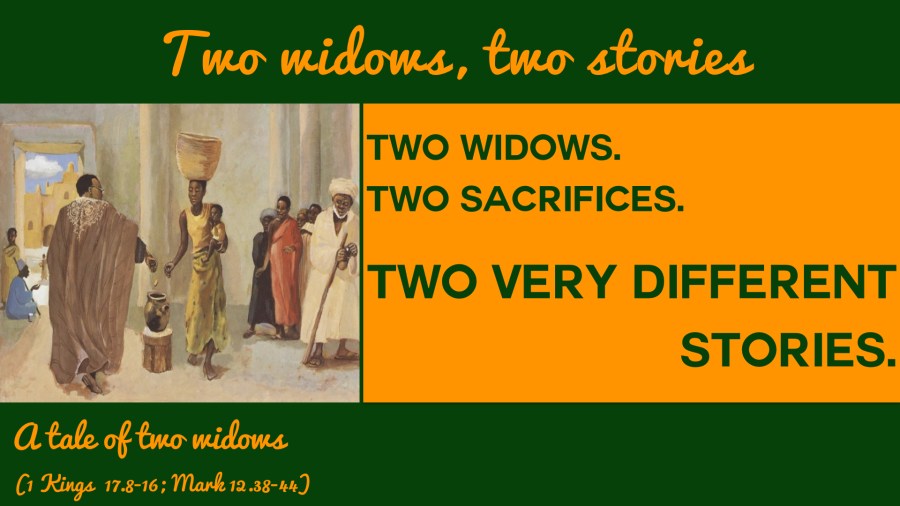
Today’s reading (Psalm 146:6-10) starts out singing heartfelt praises to the Almighty God for being an abundant helper. It recounts God’s resume of great works: the blind see, the hungry are fed, wrongs are made right, and much more. Anyone who has prayed for and gotten a miracle shares a bond with the Psalmist for their happy ending. Many of us though, don’t get the answers to our prayers that we want. It seems that God is not listening. Why can’t we be like the lucky ones? Is there a magical formula to follow? Does the Lord play favorites? What are we doing wrong? Let’s explore this question by comparing the two widows in our readings today.
It hadn’t rained for a long time, and everyone was suffering. The Lord had provided for his prophet, Elijah, up until now, but even the brook Cherith that was sustaining him dried up. Now, God tells him to go to, of all people: a poor Gentile widow in Zarephath! The Lord informs Elijah that He has commanded her to provide for him. Apparently, she did not get the memo because when he finally gets there, Elijah finds her preparing the last of her rations for her family’s final meal and he wasn’t on the guest list. By now our prophet has learned that God doesn’t send where He doesn’t supply. He confidently assures the widow that if she bakes him some bread first, then the Almighty will make sure that her flour and oil will never run out. With nothing to lose in her desperate situation she complies; a happy ending ensues, and she comes to faith in the God of Israel. Afterwards, the widow writes a book “Psalm 146 and Me”. She makes the rounds on the talk shows. It is made into a movie and her family lives comfortably off the royalties for the rest of their lives. Alleluia! This is the feel-good kind of God story we crave, not only for the widow’s sake, but because it gives us hope that one day we too may be a winner in life’s lottery. So now, let’s take a look at widow number two in today’s reading in Mark’s gospel 12:38-44.
Jesus finishes condemning the Pharisees for, among other things, devouring widow’s houses. Then, He sits down with his disciples and watches the rich Pharisees make an impressive display of their large contributions to the Temple treasury. They astound the people with their apparent generosity and piety. Then a poor widow, who most likely had her final means of support taken away from her by those selfsame Pharisees, drops her last two mites into the chest. Jesus applies God’s heavenly multiplier to her contribution and commends her for giving more than anyone else. What becomes of the destitute widow now that she has laid everything on the altar? We hope that something miraculous happens to her as a reward for her faith and dependence on the Almighty. Most likely though, nobody cares about her, she starves to death, they bury her in an unmarked pauper’s grave, and Psalm 146 seemingly mocks the poor widow in her fate. This is a more common story.
So, why the disparity? Psalm 146 has two levels of meaning: physical and spiritual. Yes, God does rescue the desperate out of their circumstances. We hear stories about people escaping perils by the help of strangers only to discover afterwards that they were angels in disguise. You, most likely, can recall an extraordinary event in your life and wondered if God was in it. Jesus was rescued from treacherous situations because His time had not yet come…and that’s the point. Miracles aren’t done for miracle’s sake. God intervenes in the physical world in order to promote a heavenly agenda. If a miraculous intervention is called for to promote the Kingdom of God here on earth, then so be it. But, the passages of Psalm 146 take on more significance in the spiritual sense. When we view them as salvation metaphors rather than mere physical deliverances, they take on an eternal value. After all, what lasting good is in the physical? It all ends. Even those who were amazingly rescued in the Bible eventually died. In contrast, Christ’s purpose in the world was to die. He gave His life as the only sacrifice that could satisfy man’s sin debt to God (Hebrews 9:24-28). So, when in the Garden of Gethsemane, He asked His Father in heaven to rescue Him, the answer was “NO!” There were forever matters at stake.
We must have faith in God through the trials of life knowing that all things will work together for good. “Even though He slay me”, said Job. “Yet I will trust in Him.” (Job 13:15). Despite the outcome, we must too. Let us remember that for every Joseph released from prison by Pharoah, there is a John the Baptist executed by Herod. For every David that slays a Goliath, there is a martyred Stephen. For every Isaac spared from a sacrificial knife, there is a Christ with a spear in His side. (Praise God for that!) Jesus triumphed over our greatest adversaries: Sin and Death. In this world we will have tribulations, but we are more than conquerors in Christ (Romans 8:37). It’s the focus on the spiritual that gives us the confidence in this physical world to face the lions…singing. Fear not those men (or situations) that can destroy the body, but rather fear God. The Lord did not rescue Jesus from the cross. He let His Son die in order to provide for us an escape from a fate worse than death. Get serious with Christ, His cross, and your salvation. Settle things now! Get into the deeper meaning of Psalm 146 and find the real happy ending.
 Cocco's Collections